- Why endpoint exploit prevention matters
- How endpoint exploits work
- Core prevention techniques
- Endpoint hardening checklist
- Conclusion: build layers, not silos
- Frequently asked questions
Share this article




Summary
Endpoints remain the primary front door to most enterprise breaches, and threat actors are exploiting these entry points faster than ever. Vulnerability exploitation has overtaken stolen credentials as the single most common way attackers break in, accounting for roughly 31% of breach entry points according to the Verizon 2026 Data Breach Investigations Report.
With AI-driven frameworks capable of turning a freshly disclosed CVE into a working exploit in under 15 minutes, the window between disclosure and attack has collapsed from months to minutes.
This guide explains what endpoint exploit prevention is, why it matters now, and the layered controls that actually stop exploits, plus a hardening checklist you can act on this quarter.
What is endpoint exploit prevention?
Endpoint exploit prevention is the set of technologies and practices that stop attackers from abusing software vulnerabilities on laptops, desktops, servers, and other endpoints to gain code execution or escalate privileges. Rather than only matching known malware signatures, exploit prevention focuses on the techniques attackers use, memory corruption, code injection, privilege escalation, and the abuse of legitimate system tools, so it can block even novel and zero-day attacks.
The distinction matters because a striking 82% of detections in 2026 are malware-free, driven by "living off the land" and credential-based techniques that never drop a file to disk. Signature-based antivirus alone cannot see these attacks; exploit prevention and behavior-based controls can.
Why endpoint exploit prevention matters
The threat landscape has shifted in three important ways:
- Exploitation is now the top initial-access vector. Exploited vulnerabilities have overtaken stolen credentials as the leading way ransomware gets in, and ransomware now features in nearly half of all breaches.
- The patch window has evaporated. Autonomous AI tooling can weaponize a new CVE and begin internet-wide scanning within minutes of publication, so "we patch monthly" is no longer a defensible posture.
- The financial damage keeps climbing. Global ransomware damage costs are forecast to reach $74 billion in 2026, up about 30% from $57 billion in 2025, according to Cybersecurity Ventures. Prevention is far cheaper than recovery.
How endpoint exploits work
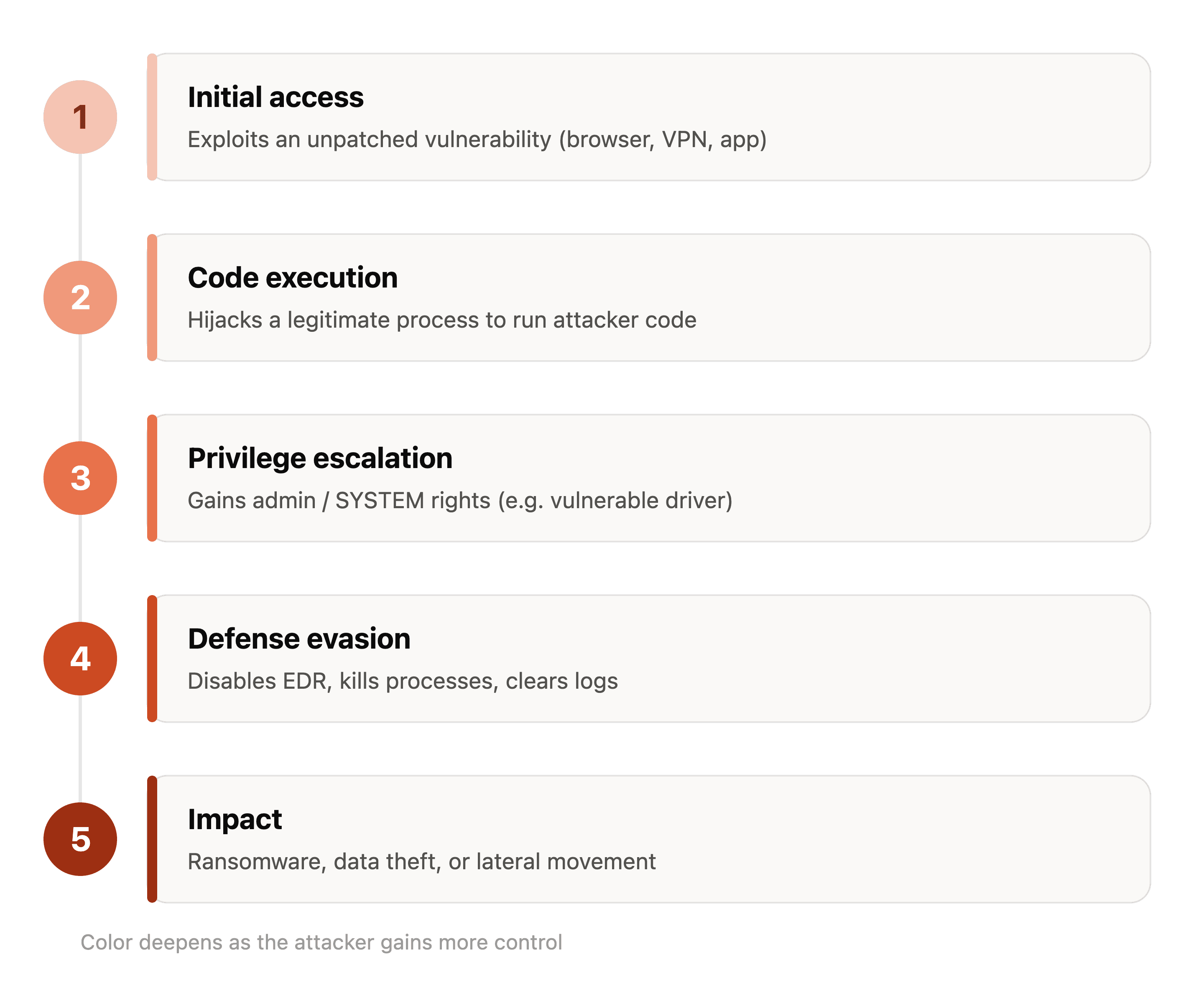
Understanding the attack chain helps you place the right controls. A typical exploit-based intrusion follows a predictable path:
Core endpoint exploit prevention techniques
1. Memory protection and anti-exploit
Exploit mitigation technologies watch for the behaviors exploits depend on, return-oriented programming, heap spraying, stack pivots, and code injection, and terminate the process before payload execution. Features like Data Execution Prevention (DEP), Address Space Layout Randomization (ASLR), and Control Flow Guard raise the cost of memory-corruption attacks and should be enforced across the fleet.
2. Rapid, risk-based patch management
Because exploitation now happens in minutes, patch prioritization must be automated and risk-based. Categorize assets by business criticality, apply patches for actively exploited CVEs within 24 hours, and use automated rollback triggers so speed doesn't compromise stability. An accurate asset inventory is the foundation. You can't patch what you can't see.
3. Application control and allowlisting / blocklisting
Allowlisting lets only approved software run, shrinking the attack surface dramatically. Pair robust application control with driver blocklists to stop "bring your own vulnerable driver" attacks, and with script controls that constrain PowerShell, WMI, and other tools attackers abuse to live off the land.
4. EDR / XDR with behavioral detection
Next-gen endpoint detection and response adds behavioral analytics and machine-learning models that flag suspicious activity even when no malware file exists. Modern XDR extends this across endpoints, identity, email, and network for correlated detection.
5. Tamper protection and absence-based monitoring
Attackers increasingly try to kill the security agent itself, so enable tamper protection, lock down privilege, and add "health and heartbeat" monitoring across the fleet. When expected telemetry suddenly drops or an agent slips into a degraded state, treat that silence as the alert, rather than waiting for a suspicious event that a blinded agent will never report.
6. Least privilege and identity controls
Removing local admin rights blocks most privilege-escalation paths outright. Combine with MFA or passkeys, just-in-time admin access, and identity threat detection to close the credential-based gaps that endpoint controls alone can't cover.
Endpoint hardening checklist
Use this checklist to benchmark your program:
- Maintain a complete, continuously updated asset inventory.
- Deploy NGAV + EDR fleet-wide with anti-exploit and device control enabled.
- Patch actively exploited vulnerabilities within 24 hours; automate the pipeline.
- Enforce application allowlisting and vulnerable-driver blocklists.
- Remove local admin rights and enforce least privilege.
- Turn on tamper protection and alert on agent-degraded or missing telemetry.
- Require phishing-resistant MFA (passkeys) for all users.
- Integrate endpoint, identity, email, and network detection (XDR/NDR).
- Test and rehearse incident response, including ransomware recovery.
Harden every endpoint from one console. Automate patching, application control, device control, and vulnerability management with ManageEngine Endpoint Central.

Conclusion: build layers, not silos
No single tool prevents endpoint exploits. The organizations that stay resilient in 2026 combine fast risk-based patching, memory protection, application control, behavioral EDR/XDR, tamper resistance, and least privilege into a defense-in-depth program, and they monitor for the silence that signals a blinded agent. A unified endpoint management and security platform like ManageEngine Endpoint Central can bring many of these controls, patching, application control, device control, and vulnerability management, under a single console, which makes a layered strategy far easier to operate at scale. Start with the checklist above, close your biggest gaps first, and treat exploit prevention as an ongoing operational discipline rather than a one-time purchase.
 About the author