About Zoho Corporation
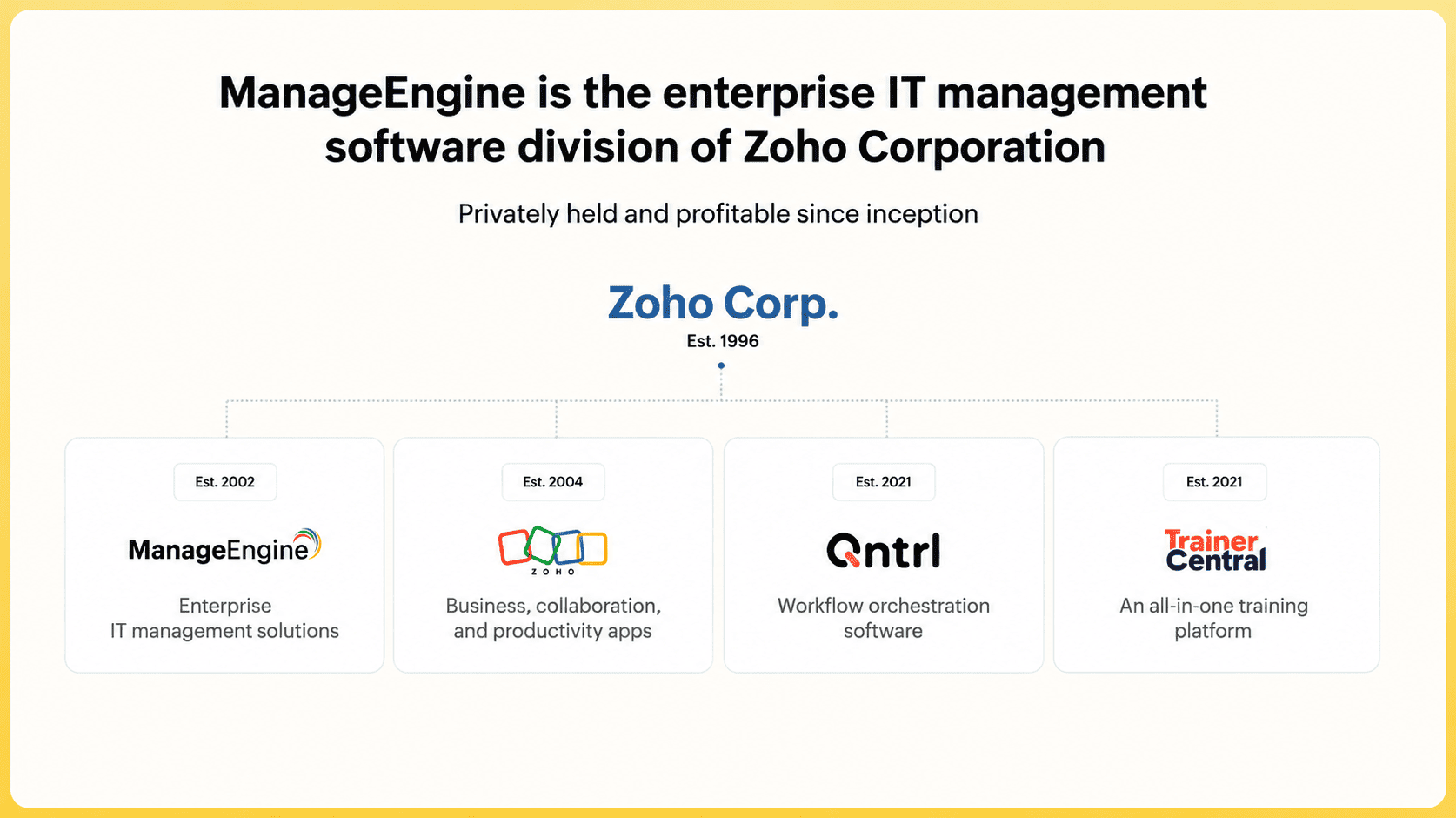
Zoho Corporation was founded in 1996 and has been profitable since its inception. It is privately held, with no outside investors. The company has restructured its portfolio into four main divisions: ManageEngine (enterprise IT management), Zoho.com (business software), Qntrl (workflow orchestration), and Trainer Central (online learning).
About ManageEngine
ManageEngine is the enterprise IT management division of Zoho Corporation. It has been building IT management software since 2002 and today offers more than 60 enterprise products spanning unified endpoint management, identity and access management, service management, network and server monitoring, security information and event management (SIEM), and IT analytics.
All software is developed in-house: ManageEngine does not acquire products from third parties. Pricing is published on the website with no hidden costs, and the software licenses are not restricted by company size.
ManageEngine History
Zoho Corporation started off by building SNMP APIs and Network Management Platforms for Network and Element Management Systems for the Telecom domain way back in 1996. WebNMS Framework was rated number one EMS/NMS Platform for Telecoms and is a carrier grade platform with over 1000 Man Years of development. During the dot com burst and telecom slowdown, early 2000s, Zoho Corporation diversified in to the Enterprise IT Management space.
As a result, ManageEngine, as a brand targeting Enterprise IT Management, was born. The carrier grade platform used for large telecoms was used as the basis for the new products in the IT Management Space.
Our Philosophy
We believe in innovation and invest heavily on Research and Development. One hundred percent customer-focused. Zoho Corporation believes in providing customers with the best software at affordable prices.
About Endpoint Central
Endpoint Central is ManageEngine's unified endpoint management (UEM) and security solution. It lets IT teams manage and secure laptops, desktops, servers, smartphones, and tablets from a single console, across Windows, macOS, Linux, iOS, Android, Chrome OS, tvOS, and iPadOS.
From automated patching and software deployment to remote troubleshooting, device control, and vulnerability remediation, Endpoint Central is designed to consolidate the tools that would otherwise be spread across multiple products. It is available as an on-premises installation and as a cloud service, in four editions sized for different organization types.
Endpoint Central also sells its major capability areas as standalone products, so organizations can license only the features they need.
Endpoint Central Features
Endpoint management
Endpoint Central automates the full device lifecycle, from onboarding and configuration to retirement. IT teams can deploy software using a library of over 10,000 pre-built templates, apply OS and third-party patches automatically, and remotely access any managed device as if they were physically present. Real-time hardware and software inventory runs continuously, giving administrators an accurate picture of every asset on the network.
Endpoint security
The security layer covers vulnerability detection and remediation, application control, device control, browser security, BitLocker management, and data loss prevention (DLP). Over 50 pre-configured policy templates are available for common requirements including USB device control, power management, and security baselines. Endpoint Central also supports ransomware detection, Endpoint Detection and response (EDR), Private access and automated incident response workflows.
Digital employee experience
Endpoint Central monitors endpoint health metrics continuously so IT teams can detect and resolve performance issues before users notice them. Self-service capabilities let employees access corporate resources and raise requests without waiting on IT, reducing ticket volume and improving response times.
Compliance
Endpoint Central includes ready-made compliance templates for HIPAA, GDPR, SOC 2, PCI DSS, and CIS Controls. Automated remediation workflows help organizations maintain a continuous compliance posture rather than preparing for audits reactively.