Knowledge Base

How to back up Exchange Online mailboxes using RecoveryManager Plus

In this article:

Objective

This article explains how to back up Exchange Online mailboxes using RecoveryManager Plus. It helps IT administrators protect critical Microsoft 365 mailbox data by setting up backup schedules, automating mailbox selection, applying customizable retention policies, and securing them with encryption.

This functionality is crucial for ensuring data protection, meeting compliance requirements, and supporting disaster recovery, enabling organizations to quickly restore mailbox items in the event of accidental deletion, data corruption, or security breaches.

Prerequisites

  • A Microsoft 365 tenant configured in RecoveryManager Plus.
  • The account used to configure a Microsoft 365 tenant in RecoveryManager Plus should be a member of the Organization Management role group.

Steps to backup Exchange Online mailboxes

  1. Log in to RecoveryManager Plus as an administrator.
  2. Navigate to the Exchange tab > Backup Settings.
  3. Click the Create Backup button located at the top-right corner of the screen.
  4. In the Tenant Details section, select Microsoft 365 in the Exchange Type drop-down.
  5. If you’ve configured multiple Microsoft 365 tenants, choose the tenant for which you wish to create a backup schedule from the Tenant drop-down.
  6. In the Backup Details section, provide a name for the backup schedule.
  7. Select the mailboxes that you wish to back up by clicking the add icon Add icon in the Select Mailboxes field, or you can import the mailboxes that you wish to back up from CSV files by clicking the import icon Import CSV icon. After you’ve selected all the mailboxes that you wish to back up, click OK.
  8. If you wish to automate the backup schedule based on certain conditions, enable the Automate Mailbox Selection toggle bar.
    • Set the conditions based on the options (Display Name, Email, Recipient Type, Group, or Mailboxes) in the Automation Settings popup. A schedule will run every day to discover the created, modified, and deleted mailboxes, and these mailboxes will be validated against the condition set. If any of these mailboxes satisfies the conditions, it is automatically added to the selected backup job.
    • Select the Validate existing mailboxes selection with automation criteria check box to periodically validate the existing mailboxes in this backup schedule against the criteria and add mailboxes that satisfy the criteria and remove mailboxes that don't satisfy the criteria.
  9. Select the mailbox folders that you wish to exclude from being backed up in the Mailbox Folders to Exclude drop-down.
  10. From the Backup Frequency drop-down, select the desired frequency at which the schedule must run from the options available
    • Daily: Scheduler will run once every day at the scheduled time.
    • Weekly: Scheduler will run once every week on the specified day and time.
    • Monthly: Scheduler will run once a month on the specified date and time.
  11. Select the repository in which you wish to store the backups from the Select Repository drop-down.
  12. In the Item-level retention field, enter the number of days/months/years for which Exchange Online backups should be stored. Backups older than the specified age will be discarded. To learn more about how RecoveryManager Plus processes the item-level retention, click here.

    You can also configure RecoveryManager Plus to store your Exchange Online backups forever, in which case backups will not be discarded.

    Note: The minimum Item-level retention for Exchange Online backups is 30 days.

  13. If you wish to encrypt your backup data, check the Encrypt backup data check box and provide the Encryption Key.
  14. When backed up items exceed their item-level retention, you can export them to a PST file before deleting them by tapping on the Enable Archive Data toggle in Advanced Settings.
    • If you have enabled archive settings, provide the location where you wish to store the PST from the Select Archive Repository drop-down.
    • If you wish to add an additional layer of security for your PST, check the Protect archived PST with a password check box and provide a password.
  15. Click Save to save the scheduler, and the backup will run at the specified time.
  16. Click Save & Run to save the scheduler and trigger the first backup process immediately.
  17. Click Cancel to exit the configuration screen.
    1
     

    Choose the mailboxes to include in the backup schedule

    1
     

    Configure the schedule and frequency for the backup to run

    Backing up Exchange Online mailboxes

    Figure 1: Backing up Exchange Online mailboxes in RecoveryManager Plus.

    Choose the mailboxes to include in the backup schedule
    Configure the schedule and frequency for the backup to run
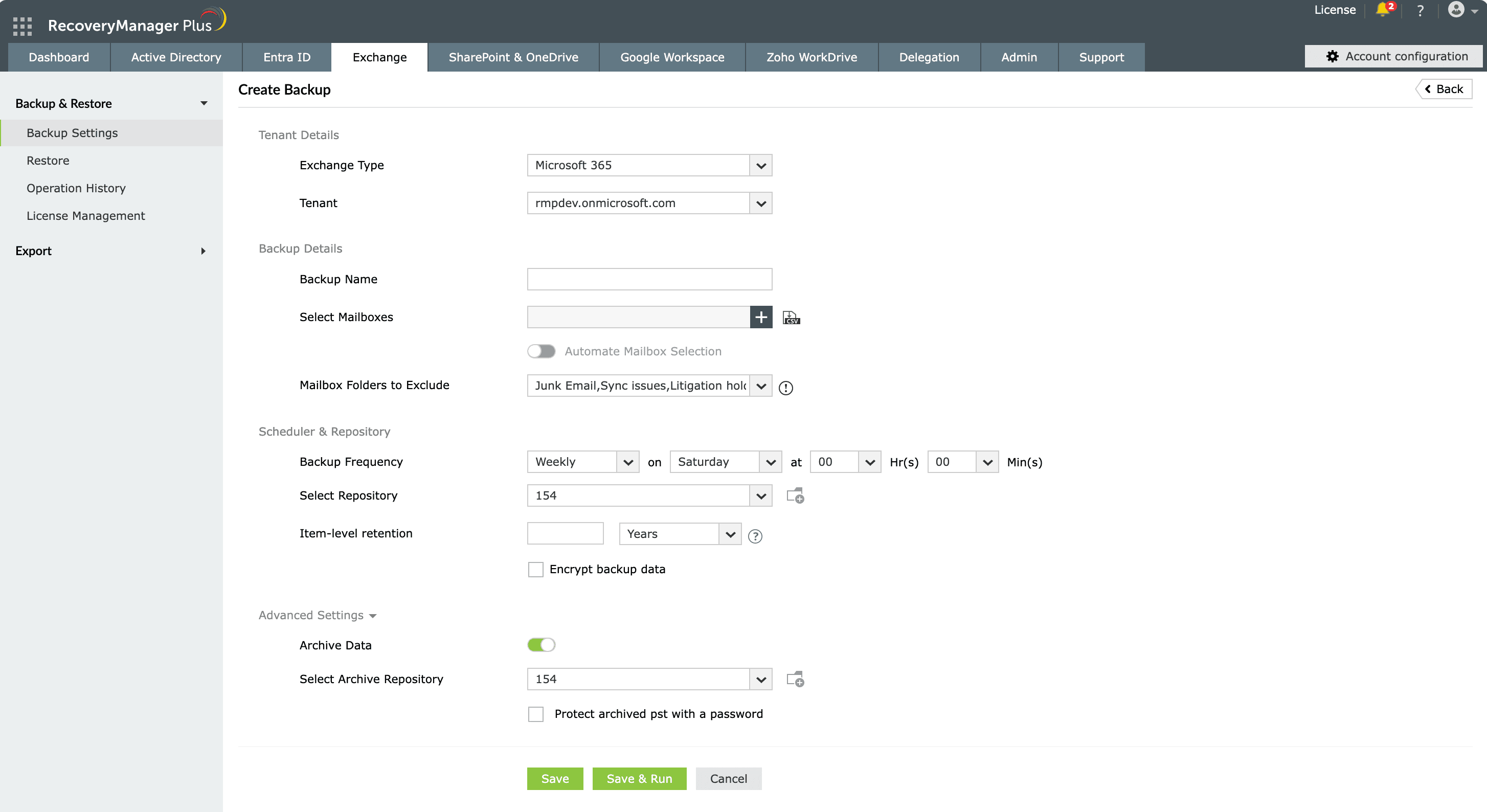
By following these steps, you can securely back up Exchange Online mailboxes with RecoveryManager Plus.

Once you’ve configured a backup schedule, you can perform the following actions:

  • Edit the backup schedule: Click the edit icon Edit icon under the Action column of the corresponding backup schedule.
  • Enable or disable the backup schedule: Click the enable icon Enable icon/disable icon Disable icon under the Action column of the backup schedule that you wish to enable or disable.
  • Manually trigger a backup: Click the backup now icon Backup icon under the Action column of the backup schedule to trigger a backup.
  • Stop a backup: Click Stop under the Last Run Status column of the backup schedule to stop the backup operation.
  • Delete the backup schedule: Click the delete icon Delete icon under the Action column of the backup schedule that you wish to delete.

Last updated on: 23-05-2025

Need further assistance?

Fill this form, and we'll contact you rightaway.

Request Support

  •  
  • *
     
  • *
     
  • *
     
  • By submitting you agree to processing of personal data according to the Privacy Policy.

"Thank you for submitting your request.

Our technical support team will get in touch with you at the earliest."

A single pane of glass for AD, Entra ID, Microsoft 365,
Google Workspace, Exchange, and Zoho WorkDrive backup.
  • » Personal WorkDrive backup
  • » Backup retention
  • » Incremental backup