Empowering green IT through intelligent data center environmental monitoring
Data centers have become the backbone of digital transformation: driving cloud adoption, AI workloads, and global connectivity. However, with demand soaring, the stakes are higher than ever. Rising energy costs, stringent ESG commitments, and tightening regulatory mandates make efficient data center monitoring not just important but indispensable.
The risks extend beyond cybersecurity: temperature spikes, power fluctuations, and compliance gaps can be equally disruptive, often leading to costly outages and reputational damage. According to the IEA, data centers accounted for nearly 20% of global electricity usage in 2024, underscoring the urgent need for sustainable operations and real-time visibility into energy consumption, infrastructure health, and compliance readiness.
Data center environmental monitoring: What does it entail
Data center environmental monitoring involves monitoring environmental conditions such as humidity, temperature and water. By allowing data center operators to become aware of environment-related issues within the data center facility, it helps them take preventive measures to eliminate environmental impact. Data center environmental monitoring leverages sensor-based networks to capture real-time insights on temperature, humidity, airflow, power consumption, etc and feed into DCIM software to receive alerts whenever a threshold is breached.
Essential step towards green IT: Why is this crucial now?
Governments worldwide are responding with stricter regulations to curb energy consumption and carbon emissions. For instance, the European Union's Green Deal and the U.S. Clean Energy Standard aim to significantly reduce emissions from data centers. Compliance with these regulations necessitates comprehensive monitoring and optimization of energy use. To meet these regulatory demands and ensure sustainability, enterprises must now align with a growing set of sustainability and operational mandates:
- Power Usage Effectiveness (PUE): Optimize cooling and power relative to IT load.
- ISO 50001: Enforce continuous energy management and improvement.
- ESG Reporting: Track energy consumption and carbon emissions to meet stakeholder and regulatory expectations.
Meeting these requirements demands real-time visibility, predictive insights, and unified monitoring, not point solutions or siloed approaches.
4 key risks modern data centers confront
- Misaligned cooling and energy allocation not only increase operational costs but also amplify environmental impact. Without data-driven optimization, cooling lapses, equipment failures, or energy waste can trigger costly shutdowns and hinder sustainability objectives.
- The absence of predictive capacity planning leads to either over-provisioning, wasting energy and resources or under-provisioning, which can create performance bottlenecks. Moreover, frequent failures in critical backup power infrastructure, like UPS systems, transfer switches, and generators, expose data centers to unplanned outages and downtime.
- When monitoring is divided across multiple IT, network, storage, and environmental systems, stakeholders lack unified visibility. This fragmentation prevents effective correlation of performance, energy use, and compliance data, ultimately compromising decision-making and rapid risk mitigation.
- Insufficient environmental safeguards and overlooked maintenance can swiftly escalate to operational incidents, regulatory penalties, and reputational damage. Reliable monitoring and routine upkeep are essential to maintain continuous compliance and service availability.
Data center environmental monitoring with OpManager
OpManager provides a unified monitoring platform that brings IT, network, server, storage, and environmental metrics together, helping enterprises align with both operational and sustainability objectives.
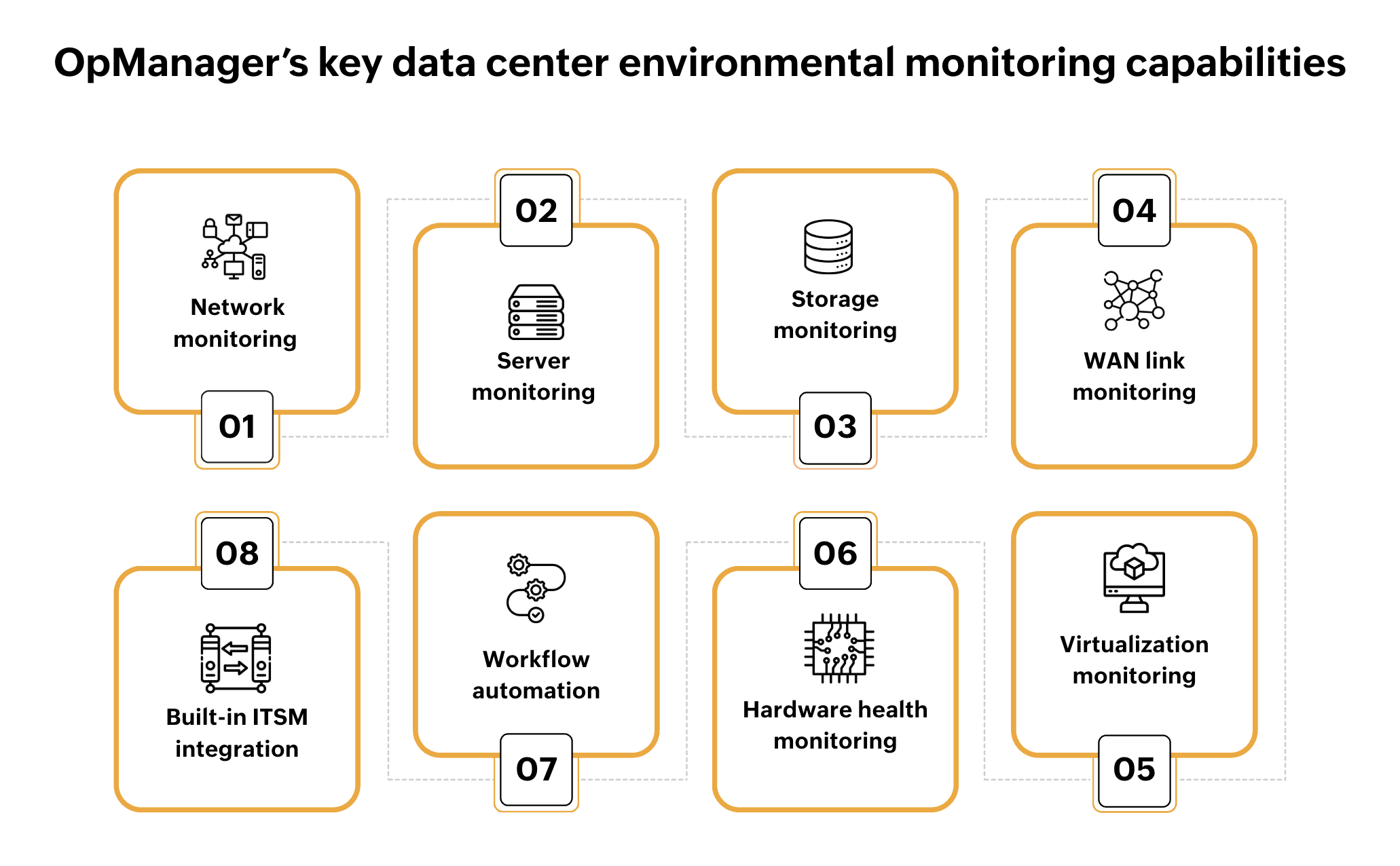
- Leverage multi-vendor network monitoring, server monitoring, and storage monitoring in a single console to eliminate siloed tools and speed troubleshooting across your infrastructure.
- Gain actionable visibility into performance and availability with WAN link monitoring and virtualization monitoring for VMware, Hyper-V, Nutanix, and Citrix. Correlate network paths, VM health, and application impact from one view.
- Understand energy consumption and thermal risk with hardware health monitoring for rack and metrics such as temperature, fan speed, and power supply status.
- Streamline operational workflows and accelerate incident closure with workflow automation and built-in ITSM integrations, so teams can remediate issues faster and focus on strategic initiatives.
- Prevent overprovisioning and optimize resource utilization with capacity forecasting reports. Use historical and projected trends to support PUE tracking and align with ISO 50001 energy-management practices.
Modern data centers must do more than just “stay online.” They need to operate sustainably, meet regulatory and ESG expectations, and optimize resources for next-generation AI workloads. With OpManager, enterprises move from reactive firefighting to strategic, insight-driven operations, achieving operational excellence while reducing costs and supporting green IT initiatives.
Schedule a personalized demo with our product experts to embark on your IT's sustainable journey or book your 30-day free trial
