Informes de Windows AD
Los informes AD de ADManager Plus ofrecen a los administradores toda la información esencial que necesitan sobre su infraestructura y objetos de AD. La biblioteca de informes de esta herramienta de informes de AD basada en la web contiene más de 200 informes out-of-the-box. Estos informes obtienen datos vitales, como los tiempos reales de inicio de sesión del último usuario, los usuarios de AD inactivos, los miembros del grupo, incluidos los miembros del grupo anidados, los permisos de NTFS, las cuentas de usuario creadas recientemente, modificadas o eliminadas, las listas de distribución, los grupos de seguridad y sus miembros y los GPO.
A diferencia de las herramientas convencionales de Microsoft y los complicados scripts de PowerShell, ADManager Plus le permite generar fácilmente informes de AD para usuarios, listas de distribución, grupos de seguridad, equipos y contactos, sin necesidad de programación. Este software de informes de AD puramente basado en GUI también le ayuda a generar informes sobre buzones de Exchange Server, Microsoft 365, Exchange Online, Google Workspace, Skype for Business (anteriormente Lync y LCS) y mucho más desde una consola.
Biblioteca de informes de AD de ADManager Plus
ADManager Plus, un software de informes de AD, tiene los siguientes informes:
| PowerShell | ADManager Plus |
|---|---|
|
|
|
|
|
|
|
|
|
|
|
|
Active Directory reports in ADManager Plus
How to pull a report from Active Directory using ADManager Plus
Pick your report
Choose from over 200 predefined Active Directory reports or create custom reports on users, groups, computers, and other Active Directory objects.
Apply filters
Set report parameters including date ranges, domains, OUs, user groups, and more.
Generate and export Active Directory reports
Execute reports instantly and export them in formats such as CSV, PDF, HTML, XLSX, and CSVDE.
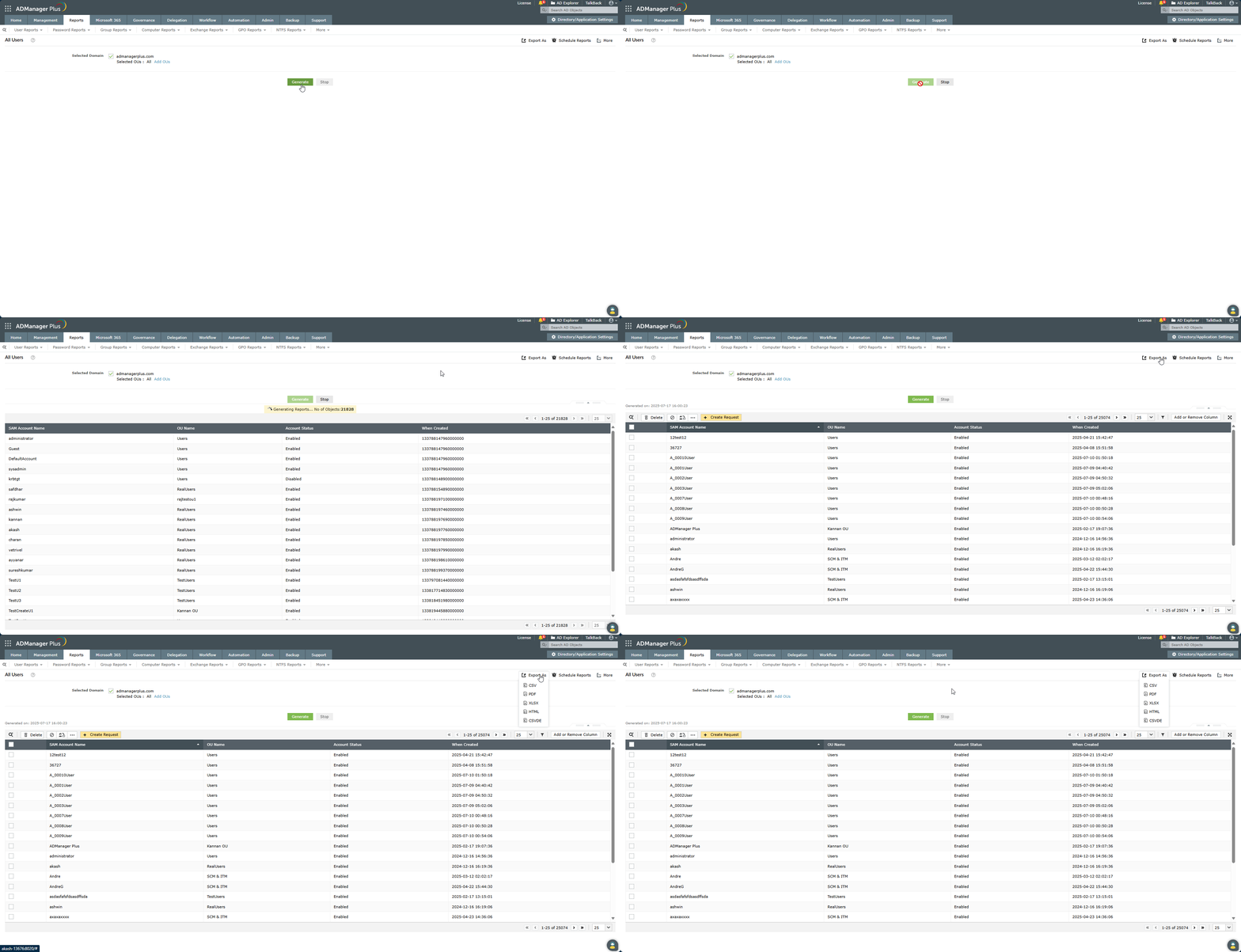
ADManager Plus reports library
| Report Name | Description |
|---|---|
| All Users report | Lists all Active Directory user accounts, including inactive AD users. |
| Real last logon | Shows the real last logon time of users in the selected domain. |
| Users' group membership report | Lists all groups in which the selected users are members. |
| Inactive Users | Lists all users with no logon activity during the specified period. |
| All computers | Lists all computer accounts located in the selected AD domain. |
| Locked out users | Shows all the locked out users accounts in Active Directory |
| Inactive computers | Shows computers that have been inactive for the specified time frame. |
| Recently bad logged users | Shows all user accounts for which the specific attributes are empty. |
| Disabled users | Lists all disabled user accounts in the specific AD domains. |
| Never logged on | Fetches user accounts from which no logon activity has even happened. |
| Users with password never expires | Displays user accounts whose password expiry date is set as never. |
| Recently logged on | Displays all AD users who logged during the specified period. |
| Soon to expire | Lists user accounts that will expire during the specified time period. |
| OS based computers | Fetches all computers running on the specified OS version. |
| Groups without members | Fetches all the empty groups present in Active Directory. |
| Permissions for folders | Shows users and groups with access to the selected shared folders. |
| Shares on server | Lists all shared folders in the chosen servers with their permissions. |
| All Users | Lists all Active Directory user accounts, including inactive AD users. |
| Users with Empty Attributes | Shows all user accounts for which the specific attributes are empty. |
| Users with Duplicate Attributes | Displays all users who have the same value for the specified attribute |
| Users Without Managers | Fetches all user accounts for which the manager attribute is empty. |
| Manager Based Users | Identifies all users with the same value for the manager attribute. |
| All Managers | Lists all users who are managers. / Lists all managers in the organization. |
| Users in more than one group | Shows all users who are members of more than one AD group. |
| Recently Deleted users | Displays all the users accounts deleted during a specified period. |
| Recently Created Users | Fetches all user accounts created during the specified period. |
| Recently Modified Users | Shows all user accounts modified during the mentioned time interval. |
| Photo Based Reports | Lists all users who have a profile photo or the ones who don't. |
| Lync/Skype Enabled Users | Displays all Skype/Lync enabled user accounts in the domain. |
| Lync/Skype Disabled Users | Lists all users for whom the Skype/Lync account isn't enabled. |
| Dial-in Allow Access | Shows all AD users for whom Dial-in access has been enabled. |
| Dial-in Deny Access | Lists all AD users who do not have the dial-in access permission. |
| Users with Logon Script | Displays user accounts a logon script assigned to them. |
| Users without Logon Script | Fetches all user accounts for which no logon script is assigned. |
| Users' group membership report | Lists all groups in which the selected users are members. |
| Disabled Users | Lists all disabled user accounts in the specific AD domains. |
| Locked-out Users | Shows currently locked out AD user accounts. |
| Account Expired Users | Fetches all Active Directory user accounts that have expired. |
| Recently Account Expired Users | Displays user accounts that expired during the specified time period |
| Soon-to-expire User Accounts | Lists user accounts that will expire during the specified time period. |
| Account Never Expires Users | Shows all user accounts for which the expiry date is set as never. |
| Smart Card Enabled Users | Fetches all users for whom the smart card-based login is enabled. |
| Inactive Users | Lists all users with no logon activity during the specified period. |
| Recently Logged On Users | Displays all users who logged in during a specific time period. |
| Logon Hour Based Report | Lists users who can logon during specific hours, or the ones who cannot. |
| Users Never Logged On | Fetches user accounts from which no logon activity has even happened. |
| Enabled Users | Fetches all enabled user accounts in the selected AD domain. |
| Users in Groups | Lists users who are members of the chosen groups, and nested groups. |
| Groups for Users | Fetches all groups in which the selected users are members. |
| Report from CSV | Shows details of all AD objects mentioned in the CSV file. |
| Recent Logon Failures | Lists user accounts with failed logons during the specified period. |
| Users with Cannot Change Password | Shows user accounts whose passwords cannot be changed by their users. |
| Users with Password Never Expires | Displays user accounts whose password expiry date is set as never. |
| Users with Change Password at Next Logon | Shows user accounts whose passwords must be changed at the next logon. |
| Password Expired Users | Fetches user accounts whose passwords have expired. |
| Soon-to-expire User Passwords | Displays users whose passwords will expire during the chosen period. |
| Password Changed Users | Lists users who changed their passwords during the specified time. |
| Password Unchanged Users | Shows users whose passwords weren't changed for the chosen period. |
| Group Members | Lists all members of the selected groups, and their nested groups. |
| Detailed Group Members | Shows objects which are members of chosen groups and their nested groups. |
| Groups Without Members | Fetches all the empty groups present in Active Directory. |
| Users Only Members of Domain Users Group | Displays all users who are members of only the domain users group. |
| Users Not in Groups | Lists all user accounts which are not members of the selected groups. |
| Computers Not in Groups | Shows computer objects which are not members of the chosen groups. |
| Users' group membership report | Lists all groups in which the selected users are members. |
| All Groups | Fetches all groups available in Active Directory. |
| Recently Created Groups | Shows all groups created during the specified period in AD. |
| Recently Modified Groups | List all AD groups modified during the chosen time period. |
| Recently Deleted Groups | Displays all groups deleted from AD during a specific time frame. |
| Top N Big Groups | Lists the top N groups in AD based on their members count. |
| Managed Groups | Fetches all groups for which a specific manager is assigned. |
| Unmanaged Groups | Displays all AD groups which do not have a manager assigned for them. |
| Security Groups | Lists all the security groups available in Active Directory. |
| Distribution Groups | Shows all AD distribution groups available in the selected domain. |
| Group Type and Scope | Displays all groups matching the specified group type and group scope. |
| All Computers | Lists all computer accounts located in the selected AD domain. |
| OS Based Report | Fetches all computers running on the specified OS version. |
| Workstation Computers | Shows all computers including member servers present in AD domains. |
| Domain Controllers | Displays all domain controllers (DCs) located in the chosen domains. |
| Computers Trusted for Delegation | Fetches the list of all computers that are trusted for delegation. |
| Bitlocker Recovery Keys | Lists all Bitlocker recovery keys stored in the selected AD domains. |
| Computers with Duplicate Attributes | Shows computers accounts having same values for the chosen attributes. |
| Bitlocker Enabled Computers | Lists computer accounts for which the Bitlocker encryption is enabled. |
| Bitlocker Disabled Computers | Lists computer accounts for which the Bitlocker encryption is disabled. |
| Active Computers | Fetches the list of all active computer objects in AD. |
| Inactive Computers | Shows computers that have been inactive for the specified time frame. |
| Enabled Computers | Fetches all enabled computer accounts from the selected domains. |
| Disabled Computers | Displays all disabled computer accounts in the chosen domains. |
| Recently Created Computers | Lists all computer accounts created during the selected period. |
| Recently Modified Computers | Shows all computer accounts modified during the chosen time interval. |
| Recently Deleted Computers | Displays the AD computer accounts deleted during the specified period. |
| Managed Computers | Fetches computer accounts which have a manager assigned to them. |
| Unmanaged Computers | Lists all computer accounts which do not have a manager. |
| Users without Mailbox | Displays all users who do not have a mailbox created for them. |
| Mailbox Enabled Users | Shows all AD users who have their own Exchange mailbox. |
| Mail Enabled Users | Lists all mail enabled users in the selected AD domain. |
| Mail Enabled Groups | Fetches all mail enabled groups present in the chosen AD domains. |
| Users with Email Proxy Enabled | Shows all users who have a proxy email address. |
| Groups with Email Proxy Enabled | Displays all groups which have a proxy email address. |
| Default Sending Message Size | Lists users with the default sending message size limit. |
| Restricted Sending Message Size | Shows all users with restrictions on the sending message size. |
| Default Recipient Size | Displays users who have the default recipient size limit. |
| Restricted Recipient Size | Fetches all users with restrictions on the recipient size. |
| Default Receiving Message Size | Lists all users with the default receiving messages size. |
| Restricted Receiving Message Size | Shows users for whom the receiving message size is restricted. |
| Default Storage Limit | Displays all users with the default storage limits for their mailboxes. |
| MailBox Size Limits | Fetches all users for whom mailbox size limits are set. |
| Users Hidden from Exchange Address Lists | Lists users whose email address is hidden from Exchange address lists. |
| Accept Messages from Everyone | Shows all users who can accept messages from everyone. |
| Accept Messages Restricted | Lists all users who can accept messages only from the specified users. |
| Users based on ForwardTo | Fetches all users for whom a forward to address is set. |
| Distribution List Members | Lists accounts who are members of any distribution group in the domain. |
| Non-Distribution List Members | Shows all accounts who are not members of any distribution group. |
| OMA Enabled | Display users for whom Outlook mobile access (OMA) is enabled. |
| OWA Enabled | Fetches users for whom the Outlook web access (OWA) is enabled. |
| POP3 Enabled | Shows all POP3 enabled users in the domain. |
| Active Sync Enabled | Fetches users for whom the ActiveSync option is allowed. |
| IMAP4 Enabled | Lists user accounts for whom the IMAP4 option is enabled. |
| OMA Disabled | Shows users for whom Outlook mobile access (OMA) is disabled. |
| OWA Disabled | Fetches users for whom Outlook web access (OWA) is disallowed. |
| POP3 Disabled | Displays users accounts who have the POP3 option disabled. |
| IMAP4 Disabled | Lists users for whom IMAP4 is disabled. |
| Active Sync Disabled | Shows user accounts for whom the ActiveSync option is disallowed. |
| Dynamic Distribution Group Members | Shows users who are members of Microsoft 365 dynamic distribution groups. |
| All Contacts | Displays all contact objects available in the selected AD domain. |
| Mail Enabled Contacts | Fetches all mail-enabled contacts in the chosen domains. |
| Recently Created Contacts | Shows all contact objects created during the specified period. |
| Recently Modified Contacts | Lists the contact objects modified during the mentioned time interval. |
| Recently Deleted Contacts | Displays contact object deleted from AD during the chosen period. |
| Users' Terminal Service Properties | Displays Terminal Service settings of users in the selected domains. |
| Users With Terminal Server Access | Show all user accounts for which Terminal Server access is enabled. |
| All GPOs & Linked AD Objects | Lists all available GPOs along with the objects linked to them. |
| Recently Created GPOs | Shows all GPOs created during the specified time interval. |
| Recently Modified GPOs | Displays all GPOs edited during the selected time period. |
| Disabled GPOs | Fetches all disabled GPOs available in the domain. |
| Unused GPOs | Lists those GPOs that are not in use or applied to any object. |
| Frequently Modified Computer Settings GPOs | Shows those GPOs whose computer settings are frequently changed. |
| Frequently Modified User Settings GPOs | Displays the GPOs whose user settings are frequently edited. |
| Domain Linked GPOs | Lists all GPOs that are linked to the selected domain. |
| OU Linked GPOs | Shows GPOs that are linked to any OU in the selected domain. |
| Site Linked GPOs | Fetches GPOs that are linked to any site in the chosen domain. |
| GPO Blocked Inheritance Containers | Displays objects for which inheritance of GPO settings is blocked. |
| Computer Settings Disabled GPOs | Lists all GPOs whose computer settings have been disabled. |
| User Settings Disabled GPOs | Shows those GPOs whose user settings are disabled. |
| Frequently Modified GPOs | Fetches those GPOs that are edited repeatedly. |
| Frequently Modified GPOs | Fetches those GPOs that are edited repeatedly. |
| GPOs with Script | Lists all GPOs in which logon, logoff, startup or shutdown scripts are configured. |
| Linked GPOs Report | Fetches information on GPOs that are linked to the OUs or sites in a domain. |
| Compare GPO versions | Lists the user and computer versions of both the AD and SYSVOL of the desired GPOs. |
| Direct and Inherited GPO Links | Fetches information on all GPOs linked to the selected OUs and sites, including those inherited from parent OUs up to the root domain. |
| GPOs Linked To Empty OUs | Displays GPOs linked to OUs without security principals, with options to disable or remove links. |
| Unlinked GPOs | Fetches the list of GPOs that are not linked to any container in the domain. |
| GPOs with Inactive Policy Settings | Lists GPOs with policy settings configured within their disabled user and computer configurations. |
| GPO Delegation Report | Displays the security principals that have access to the selected GPOs and provides details on the security filters. |
| GPO Settings | Lists all Administrative Templates, security settings, and GPO preference settings for user and computer configurations in the selected GPO. |
| GPOs with Specific Settings | Displays the values of specific Administrative Templates and Security Settings in all or selected GPOs. |
| Empty GPOs Report | Lists empty GPOs from the selected GPOs or all the empty GPOs in the domain. |
| Resultant Set of Policy | Fetches the Administrative Template Policy and Security Settings applied on the selected user and computer. |
| GPO Modeling | Simulates the possible Administrative Template and Security Settings that will be applied to the selected user and computer. |
| Comparison of GPOs | Compare the Administrative Templates and security settings of different GPOs in your AD. |
| All OUs | Shows all organizations units (OUs) available in the chosen domains. |
| Empty OUs | Lists all OUs that do not contain any objects within them. |
| Users-Only OUs | Fetches those OUs which contain only user accounts. |
| Computers-Only OUs | Displays those OUs that contain only computer accounts within them. |
| Recently Created OUs | Lists all OUs created during the specified time period. |
| Recently Modified OUs | Shows those OUs that were modified during the chosen time interval. |
| GPO Linked OUs | Fetches all OUs to which a GPO is linked. |
| GPO Blocked Inheritance OUs | Displays the OUs for which inheritance of GPO settings is blocked. |
| Shares in the Servers | Lists all shared folders in the chosen servers with their permissions. |
| Permissions for Folders | Shows users and groups with access to the selected shared folders. |
| Folders accessible by Accounts | Fetches all shared folders that the chosen users and groups can access |
| Non-Inheritable Folders | Displays shared folders for which inheritance of permissions is blocked. |
| AD Objects accessible by Accounts | Shows AD objects to which the specified users and groups have access. |
| Non-Inheritable Objects | Lists all objects that cannot inherit permissions from parent objects. |
| Servers accessible by Accounts | Fetches all servers that the specified users and groups can access. |
| Subnets accessible by Accounts | Displays all subnets that the chosen users and groups can access. |
| Server Permissions | Lists all users and groups with access to the selected servers. |
| Subnet Permissions | Shows all users and groups who have access to the chosen subnets. |
| Search Permissions | Search for specific permissions across AD. |
| Shares in the Servers | Lists all shared folders in the chosen servers with their permissions. |
| Permissions for Folders | Shows users and groups with access to the selected shared folders. |
| Folders accessible by Accounts | Fetches all shared folders that the chosen users and groups can access |
| Non-Inheritable Folders | Lists all objects that cannot inherit permissions from parent objects. |
| Server Permissions | Lists all users and groups with access to the selected servers. |
| Subnet Permissions | Shows all users and groups who have access to the chosen subnets. |
| Servers accessible by Accounts | Fetches all servers that the specified users and groups can access. |
| Subnets accessible by Accounts | Displays all subnets that the chosen users and groups can access. |
| AD Objects accessible by Accounts | Shows AD objects to which the specified users and groups have access. |
| Non-Inheritable Objects | Lists all objects that cannot inherit permissions from parent objects. |
| Groups for Users | Fetches all groups in which the selected users are members. |
| Group Members | Lists all users who are members of the specified groups. |
| Inactive Users | Displays all users who have not logged in during the specified period. |
| Locked-out Users | Shows all the locked out users accounts in Active Directory |
| Users Never Logged On | Fetches user accounts from which no logon activity has even happened. |
| Recently Logged On Users | Displays all AD users who logged during the specified period. |
| Office 365 Users | Shows the details of all available Office 365 user accounts. |
| Inactive Users | Lists Office 365 users who have not logged in for the chosen period. |
| Never Logged On Users | Fetches all Office 365 users who have not logged on even once. |
| Litigation Hold Enabled Mailboxes | Lists Exchange Online mailboxes with litigation hold option enabled. |
| ActiveSync Enabled Users | Displays Office 365 users for whom the ActiveSync option is enabled. |
| Shared Mailbox | Shows the details of all available Exchange Online shared mailboxes. |
| Licensed Users | Shows all Office 365 users for whom a license has been assigned. |
| Unlicensed Users | Lists Office 365 users who do not have any license assigned to them. |
| License Details | Displays the details of all available Office 365 licenses. |
| All Groups | Lists details of all Office 365 distribution and security groups. |
| Security Groups | Shows the details of all available Office 365 security groups. |
| Distribution Groups | Displays details of all Office 365 distribution groups. |
| Group Members | Lists members of the chosen Office 365 groups and their nested groups. |
| Dynamic Distribution Group Members | Shows users who are members of Office 365 dynamic distribution groups. |
| Google Workspace Users | Lists all users in Google Workspace and their details. |
| Active Users | Displays the active Google Workspace users and their important details. |
| Suspended Users | Fetches the details of all the suspended users in your Google Workspace setup. |
| Recently Deleted Users | Displays all recently deleted users in the past 20 days. |
| Active Users | Identifies all active users in Google Workspace. |
| Suspended Users | Fetches information about the suspended users in Google Workspace. |
| Password Policy | Provides the details of the password policies of the selected domain(s). |
| Account Lockout Policy | Provides the details of the account lockout polices of the selected domain(s). |
| Printer Reports | Provides the list of Printers for the selected domain(s). |
| DC Replication Status | Fetches the replication status of the selected domain controller(s). |
| Lingering Objects | Lists the lingering objects in your AD so you can remove them. |
| Identity Risk Assessment report | Identifies the potential identity risk indicators in your AD and M365 environments. |
Use cases
Use case 1: An IT admin needs to generate reports for SOX or GDPR audits
ADManager Plus provides preconfigured compliance reports on user logon activity, group memberships, inactive accounts, and permissions—all exportable in audit-friendly formats.

Use case 2: Identify and manage inactive user Active Directory accounts
A healthcare organization wants to eliminate users who have been inactive for more than 90 days to reduce security risks. Use the Inactive Users report in ADManager Plus to identify accounts that haven’t logged in over a defined period and disable them instantly.

Why choose ADManager Plus for your Active Directory reporting needs
As an AD reporting software, ADManager Plus offers:
Out-of-the-box reports
Choose from over 200 predefined Active Directory reports and generate them at the click of a button. Unlike PowerShell's command-line interface, ADManager Plus comes with an intuitive interface for faster and error-free reporting.
Automation and scheduling
Save countless hours by scheduling reports and automatically generating them to meet audit requirements.
Exportable reports
Export reports in various formats such as CSV, HTML, XLSX, CSVDE, and PDF.
Actionable reports
Manage Active Directory objects on the fly from the reports. Delete, move objects to other OUs, and more, all from the report.
Custom reports
Tailor reports to meet your organizational needs and use them like any other report.
Delegated reporting
Empower non-admins to generate specific reports without granting them excessive Active Directory permissions.
FAQs
Active Directory reporting refers to the process of generating detailed insights into the objects and activities within your Active Directory environment, such as users, groups, computers, GPOs, logon patterns, permissions, and more.
With the right AD reporting tool like ADManager Plus, IT administrators can track changes and user activity, ensure compliance, and maintain the overall health and security of the directory, without writing complex PowerShell scripts.
Active Directory stores information about the entities in your network and is quite sensitive to changes. It's important to keep an eye on your Active Directory at all times to ensure that it is up-to-date with information and there are no potential vulnerabilities in it. Active Directory reporting helps you gain visibility into your Active Directory structure, configured permissions, group memberships, group policies, and more.
ADManager Plus includes built-in scheduling capabilities. You can set up automated report generation on daily, weekly, monthly, or custom schedules. Reports can be automatically emailed to stakeholders in desired formats.
Yes, ADManager Plus allows complete customization of reports. You can modify existing reports, create custom reports from scratch, set filtering criteria, and more.
Yes, ADManager Plus provides several reports crucial for Active Directory health checks. These include reports on domain controller replication status, GPO changes, and more. By regularly reviewing these reports, admins can proactively identify potential issues, ensure optimal Active Directory performance, and maintain a clean and efficient environment.
Otras funciones
Informes de Active Directory
¡Un catálogo de casi todos los informes que necesitará de su Active Directory! Informes integrales y confiables. Programe informes para que se ejecuten periódicamente. Gestione su AD desde los informes.
Gestión de contraseñas de Active Directory
¡Restaure contraseñas y ajuste las propiedades de las contraseñas desde una sola consola web, sin comprometer la seguridad de su AD! ¡También delegue su poder para reiniciar contraseñas a los técnicos de la mesa de ayuda!
Informes de inicio de sesión de Active Directory
Monitoree las actividades de inicio de sesión de los usuarios de Active Directory en su entorno de AD. Filtre a los usuarios inactivos. Informes por hora. Genere informes sobre la verdadera hora del último inicio de sesión y los inicios de sesión recientes de los usuarios.
Flujo de trabajo de Active Directory
¡Un kit de herramientas en miniatura para la gestión de tickets de Active Directory dentro de ADManager Plus! Defina una constitución rígida pero flexible para cada tarea en su AD. Ajuste las riendas de la seguridad de su AD.
Gestión de Exchange Server
Cree y gestione los buzones de Exchange y configure los derechos de buzón con el sistema de gestión de Exchange en ADManager Plus. ¡Ahora con soporte para Microsoft Exchange 2010!
Automatización de Active Directory
Una automatización completa de las tareas críticas de AD como aprovisionamiento de usuarios, eliminación de usuarios inactivos, etc. También le permite secuenciar y ejecutar tareas de seguimiento y mezclarlas con el flujo de trabajo para ofrecer una brillante automatización controlada.