Every digital transaction, video call, or SaaS login depends on data moving across a network. But without visibility into that traffic, IT teams are essentially operating blind. That’s where network traffic analysis (NTA) comes in. It’s the practice of monitoring and examining network data to understand performance, detect threats, and ensure applications run smoothly. For modern enterprises, NTA is a core part of both IT operations and cybersecurity.
In this guide
- What network traffic analysis means, and how flow-level and packet-level visibility differ.
- The pipeline data actually follows, from collection to alerting.
- Where NetFlow Analyzer fits as an NTA platform, and what it does and does not do.
What is network traffic analysis?
At its simplest, network traffic analysis is the process of capturing, inspecting, and analyzing data packets and flows as they move across a network. This process enables IT teams to understand how resources are being used, spot irregularities, and maintain optimal performance.
Think of it as having a microscope and a telescope for your network. Sometimes, you need granular packet-level visibility to troubleshoot a single application. Other times, you need a broader, flow-level view to understand traffic patterns across the entire infrastructure. Both perspectives are important.
- Packet-level analysis: Deep inspection of individual packets, often used for troubleshooting and forensic investigations.
- Flow-level analysis: Aggregated view of traffic patterns using flow technologies like NetFlow, sFlow, or IPFIX.
Together, these approaches provide the visibility needed to optimize performance and strengthen defenses.
Why is network traffic analysis important?
Modern networks span data centers, cloud services, and remote endpoints. With this complexity, blind spots can easily emerge. If IT teams can’t see what’s happening in real time, problems can spread unnoticed—whether it’s a bandwidth bottleneck or a malicious actor trying to exfiltrate data. This is where NTA proves its value. It helps organizations:
- Performance monitoring: Identify bottlenecks, latency spikes, and bandwidth hogs.
- Security detection: Flag anomalies, intrusions, and distributed denial-of-service (DDoS) attempts.
- Compliance assurance: Provide detailed logs and audit trails to meet regulatory requirements.
- Downtime reduction: Improve mean time to detect (MTTD) and mean time to repair (MTTR), minimizing disruption.
By answering the “who, what, and why” of network traffic and usage, NTA gives IT teams the actionable intelligence needed to keep operations running smoothly.
Key components of network traffic analysis
Delivering actionable insights from network traffic is not as simple as collecting raw data. Network traffic analysis (NTA) depends on a carefully balanced combination of data sources, metrics, and tools. Each plays a distinct role, and without the right mix, visibility will always be incomplete.
Data collection methods
The foundation of NTA lies in how traffic data is captured. Different collection methods provide different levels of depth and granularity, and most enterprises rely on a blend of approaches to achieve full visibility.
- Flow-based monitoring (NetFlow, sFlow, IPFIX): These technologies export summarized flow data directly from routers, switches, and firewalls. They provide high-level visibility into who is talking to whom, which applications are in use, and how much bandwidth is consumed. Flow data is highly scalable, making it the backbone of monitoring in large or distributed networks.
- Packet capture (PCAP): When troubleshooting demands more precision, packet capture delivers full payload-level data. This method is essential for detailed forensics, application-layer troubleshooting, and security investigations. While powerful, it is resource-intensive and typically used selectively for high-value flows.
- SNMP and log data: Beyond flows and packets, device-level information collected via SNMP or system logs adds important context. These sources provide performance counters, configuration details, and error messages that complement traffic data with infrastructure-level visibility.
Metrics tracked
Once data is collected, the value comes from tracking the right metrics. Not all signals are equally important, and modern NTA platforms are designed to surface the ones that matter most.
- Bandwidth usage per user, device, or application, showing where resources are consumed.
- Latency and packet loss, which directly impact user experience, especially in voice and video traffic.
- Flow counts and session duration, helping identify abnormal behavior such as unusually long-lived connections.
- Application-specific traffic patterns, distinguishing between critical business apps and recreational or unauthorized usage.
Tools and platforms
The final component is the toolset that makes sense of the data. Most organizations use a combination of open-source and commercial platforms, depending on use case and scale.
- By combining these components, comprehensive data collection, meaningful metrics, and the right mix of tools, organizations transform raw network telemetry into actionable intelligence. This layered approach makes network traffic analysis a discipline of understanding and context. It is about improving performance, strengthening security, and aligning the network with business goals.
- Open-source tools, such as Wireshark, provide deep packet inspection capabilities and are widely used for troubleshooting and forensic analysis.
- Commercial platforms, including ManageEngine NetFlow Analyzer, SolarWinds NTA, and Cisco Secure Network Analytics (Stealthwatch), offer enterprise-grade scalability, reporting, and integration. They are designed for continuous monitoring across large, hybrid, and multi-cloud networks.
- Integrated solutions go a step further by blending traffic visibility with performance analytics and security intelligence. These unified platforms consolidate monitoring into a single pane of glass, reducing silos and providing broader operational context.
How network traffic analysis works
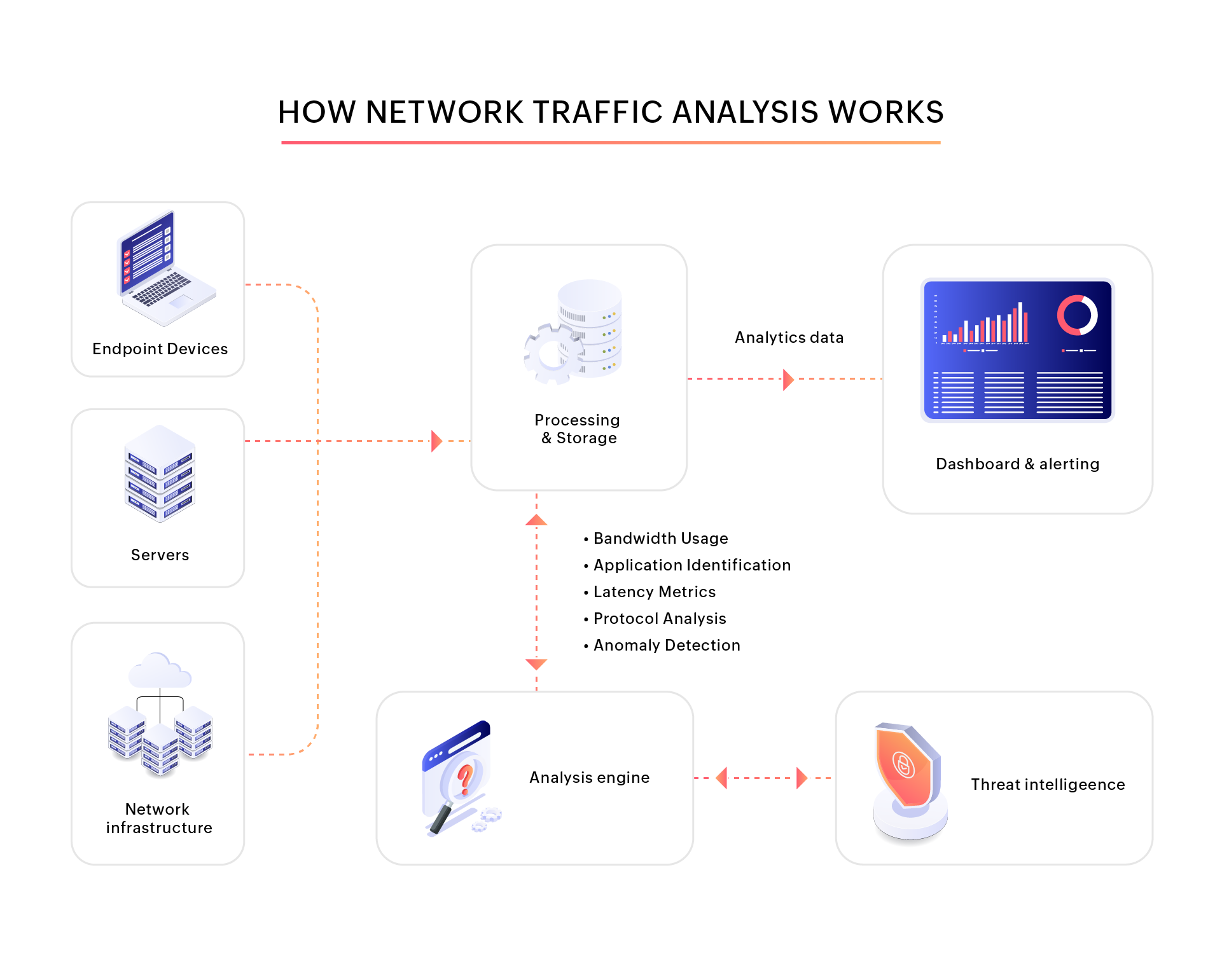
The mechanics of NTA follow a structured pipeline. Data is captured, processed, and transformed into actionable insights that IT teams can use for performance monitoring and security response. The process typically looks like this:
1. Data Capture
Routers, switches, firewalls, and other network devices export flow records (NetFlow, sFlow, IPFIX) or mirrored traffic from SPAN/TAP ports. Endpoints and servers also contribute traffic data, ensuring full network visibility. This step builds the foundation for analysis by collecting raw information across the infrastructure.
2. Normalization
Captured traffic is cleaned, standardized, and enriched with metadata in the processing and storage layer. Duplicates are removed, timestamps are aligned, and fields are made consistent. This produces a uniform dataset that can be reliably analyzed.
3. Correlation & pattern recognition
Normalized data is compared against historical baselines to spot anomalies. Correlation across devices, applications, and users highlights unusual activity such as spikes, protocol misuse, or suspicious flows. Machine learning and analytics turn raw patterns into actionable insights.
4. Dashboard, alerting, & reporting
Insights are presented in dashboards and reports that give IT teams real-time visibility. Alerts notify operators when thresholds are breached or anomalies are detected. These dashboards also provide trends and compliance metrics for strategic decision-making.
5. Remediation
Alerts are enriched with threat intelligence, adding context about known malicious IPs, domains, or attack signatures. Automated scripts, SOAR workflows, and ITSM/AIOps integrations accelerate response. Remediation actions can block traffic, throttle bandwidth, or reroute sessions to maintain service continuity.
Benefits of network traffic analysis
The advantages of network traffic analysis extend beyond simple visibility. When deployed effectively, it becomes a driver of both operational efficiency and business resilience.
- Optimized bandwidth usage: Prevents a few applications or users from monopolizing resources.
- Faster troubleshooting: Speeds up root cause analysis of slow applications or outages.
- Proactive security: Detects unusual traffic patterns before they escalate into breaches.
- Improved user experience: Ensures consistent quality of service (QoS) for mission-critical apps.
- Cost efficiency: Supports capacity planning and prevents unnecessary infrastructure spending.
With these benefits, NTA shifts IT teams from reacting to issues to preventing them.
Use Cases and real-world applications
Every organization uses its network differently, but the challenges are often similar: performance, security, and compliance. Network traffic analysis (NTA) addresses each of these areas by providing actionable insights that go far beyond raw bandwidth metrics.
- Security monitoring: Detects malicious command-and-control traffic, data exfiltration attempts, and the early stages of ransomware campaigns.
- SaaS monitoring: Tracks the performance of Microsoft 365, Salesforce, Zoom, and other cloud services across distributed teams, ensuring consistent user experience.
- Shadow IT detection: Identifies unauthorized cloud applications and unapproved services that quietly consume bandwidth and create security blind spots.
- Capacity planning: Analyzes traffic patterns to forecast growth, helping IT align infrastructure investments with future business demands.
- Compliance auditing: Creates a verifiable trail of who accessed which systems and when, supporting industry regulations and internal governance.
These use cases highlight why NTA has evolved into a capability that strengthens both operations and security. It gives IT and security leaders the assurance that the network supports growth, resilience, and trust.
Challenges in network traffic analysis
Despite its clear advantages, network traffic analysis (NTA) is not without challenges. The scale and complexity of modern networks introduce obstacles that can make analysis difficult without the right tools and strategies in place. From data overload to encrypted traffic, IT teams must navigate a range of hurdles to extract meaningful insights.
1. Data overload
Today’s networks generate staggering amounts of flow records and packet data. With thousands of devices, SaaS applications, and remote endpoints contributing traffic, the sheer volume of telemetry can overwhelm traditional monitoring systems. Without advanced filtering, baselining, and analytics, teams may struggle to separate actionable insights from background noise.
2. Encryption visibility
The widespread adoption of TLS 1.3, VPN tunnels, and encrypted application traffic has dramatically reduced what deep packet inspection (DPI) can reveal. While encryption is essential for privacy and compliance, it also blinds security and operations teams to what’s happening inside the traffic flows. Solutions must now rely on metadata, flow patterns, and fingerprinting techniques to maintain visibility without compromising security.
3. Alert fatigue
Even the most capable NTA systems can become a burden if they are not tuned correctly. Poorly configured thresholds often generate floods of false positives, burying real threats under a pile of low-value alerts. This leads to alert fatigue, where teams either ignore alerts altogether or miss critical incidents. Intelligent baselining, machine learning models, and context-aware correlation are now necessary to ensure that alerts remain meaningful.
4. Integration complexity
NTA data delivers the most value when it is connected to the broader IT ecosystem. Integration with SIEM platforms strengthens security correlation, ITOM tools expand infrastructure visibility, and AIOps platforms enable predictive analytics. Building these connections is not always straightforward, since systems often rely on different data formats. Achieving full alignment requires planning, governance, and in some cases, custom connectors.
Selecting the right NTA platform often comes down to how well it can overcome these limitations with features like AI-driven filtering, scalable analytics, and tight ecosystem integrations.
Future of network traffic analysis
As networks continue to evolve, so do the expectations placed on monitoring systems. Traditional traffic analysis that once focused on reactive troubleshooting has grown into a strategic layer for performance, security, and compliance. Looking ahead, the future of network traffic analysis (NTA) will be shaped by intelligence, automation, and unified visibility across increasingly complex environments.
- AIOps integration: The next generation of NTA platforms will use artificial intelligence to generate predictive insights from traffic data. Instead of waiting for congestion or outages, NTA will model patterns, forecast risks, and recommend corrective steps. When incidents occur, AI-driven root cause analysis will shorten investigation times from hours to minutes.
- ML-driven anomaly detection: Static thresholds are no longer effective in networks where usage fluctuates by time of day, season, or workload. Machine learning will continue to play a central role by establishing adaptive baselines, spotting deviations in multi-dimensional data, and filtering out false positives. This allows IT and security teams to focus only on meaningful anomalies whether it’s a stealthy data exfiltration attempt or an unusual spike in SaaS traffic.
- Cloud and edge visibility: With enterprises operating across multi-cloud, containerized, and edge environments, visibility must extend well beyond the traditional data center. NTA tools will increasingly provide seamless monitoring for workloads that shift dynamically across providers and for IoT or edge devices that generate unpredictable traffic patterns. Unified visibility across these domains ensures that hybrid environments are monitored as a single, cohesive system.
- Zero Trust support: As organizations adopt Zero Trust architectures, continuous traffic validation has become a requirement for organizations that want to enforce identity-based security. Future-ready NTA platforms will feed flow and behavioral data directly into access control, verifying who connects and how they behave once inside. This transforms traffic analysis from a monitoring function into an enforcement mechanism within Zero Trust.
Network traffic analysis is the backbone of modern IT operations and security. By capturing and analyzing traffic data, organizations gain the visibility needed to keep applications fast, networks secure, and downtime minimal. As networks evolve, NTA is shifting from diagnostic support toward a role as a proactive safeguard for both performance and security.
Where NetFlow Analyzer fits
ManageEngine NetFlow Analyzer is a flow-based network traffic analysis platform. It collects NetFlow, IPFIX, sFlow, J-Flow, NetStream, and AppFlow from the routers, switches, and firewalls already deployed on your network, with no new sensors required to establish full network-wide visibility. Where packet-level depth is genuinely needed, its Network Packet Sensor adds deep packet inspection at selected points, measuring Application Response Time and Network Response Time per application, URL, and conversation.
The same collected data drives three layers of the NTA pipeline covered on this page. Baselining and anomaly detection run through Security Analytics, which pairs a rule engine with machine learning and maps findings to MITRE ATT&CK tactics. Reporting and dashboards turn the same records into capacity, billing, and compliance evidence. And forwarding into SIEM platforms, syslog, Log360, ServiceNow, and Jira Service Desk connects detections to the remediation workflow your team already runs, since NetFlow Analyzer does not take automated response actions itself.
Feature highlights
- Agentless flow collection: NetFlow, IPFIX, sFlow, J-Flow, NetStream, and AppFlow from multi-vendor infrastructure, with no endpoint agents.
- Packet-level depth where it counts: The Network Packet Sensor's DPI Engine for response-time attribution, plus a NetFlow Generator mode that converts raw packets from non-flow devices into flow records.
- Security Analytics: A flow-based rule engine and machine learning model, mapped to MITRE ATT&CK, detecting beaconing, lateral movement, and exfiltration patterns without new sensors.
- Long-term retention: Months of conversation-level history for baselining, forensic reconstruction, and compliance reporting.
- ITSM and SIEM integration: Forwarding into ServiceNow, Jira Service Desk, syslog, and SIEM platforms, where response is orchestrated.
Simplify network traffic analysis with NetFlow Analyzer
Start your 30-day free trialFAQs
What is the difference between network traffic analysis and network monitoring?
Network monitoring watches device and interface health: is a link up, how busy is it, is a device responding. Network traffic analysis goes a layer deeper, examining the conversations that make up that traffic to explain who is talking to whom, over which application, and whether the pattern is normal. Monitoring tells you something is wrong; analysis tells you what and why.
Is network traffic analysis the same as NetFlow?
Do I need packet capture to do network traffic analysis?
Can network traffic analysis detect threats in encrypted traffic?
How is network traffic analysis different from NDR?

By Shynu,
ManageEngine Team