Forge a competitive edge with proactive performance insights. ManageEngine Applications Manager's APM tool guides businesses from reactive firefighting to strategic optimization for both enterprise and home-grown applications.
Download Now Demo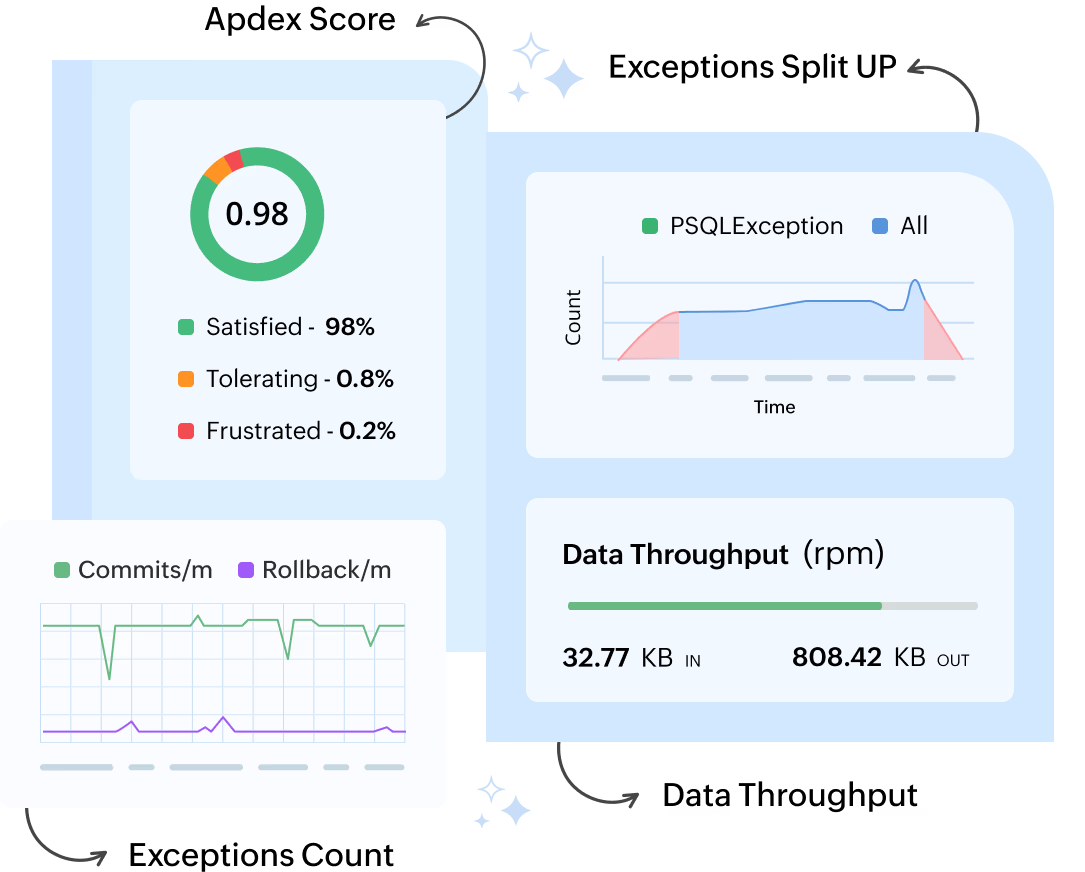
Optimized application performance at any scale
ManageEngine Applications Manager optimizes application performance with real-time insights, AI-driven analysis, and seamless scalability. With real-time analytics and a customer-centric design, our application performance monitoring tool offers a unified platform that seamlessly integrates across CI/CD pipelines, supports SLA compliance, and ensures your applications perform at their best—no matter the scale.
ManageEngine Applications Manager: Your gateway to comprehensive observability
Why observability matters with ManageEngine Applications Manager
Observability is a critical factor in ensuring the reliability and performance of applications and infrastructure, considering the intricacies involved in contemporary applications and IT landscapes. Powered by AI and ML, Applications Manager's application performance monitor captures and anlyzes vast amounts of telemetry data to provide real-time insights into the health and performance of your entire technology stack.
- Unified observability platform: Applications Manager seamlessly integrates metrics, and traces for full-stack visibility.
- AI-powered insights to anticipate and resolve issues before they impact end-users.
- Actionable analytics that connect performance data with business outcomes, bridging the gap between IT and business goals.
Why choose Applications Manager for your application performance monitoring needs?
Applications Manager provides a comprehensive application performance monitoring solution designed to help you:
- Gain deep insights: Monitor application KPIs, trace code-level performance, and analyze user behavior to identify bottlenecks and optimize performance.
- Proactively address issues: Leverage distributed tracing to pinpoint issues across complex application architectures and quickly resolve them.
- Enhance user experience: Measure end-user satisfaction, capture errors and exceptions, and improve application responsiveness.
- Optimize resource utilization: Analyze resource consumption and identify opportunities for optimization.
- Streamline DevOps: Improve collaboration between development and operations teams by providing real-time insights into application performance.
Effortless high performance with state-of-the-art Application Performance Monitoring
Applications Manager's application performance monitoring solution transcends conventional monitoring, offering real-time visibility into every facet of your business critical applications. It uses performance tracking, digital experience monitoring (DEM), AIOps, smart alerting, distributed tracing, and mapping capabilities to help improve application performance, availability, and end-user experience. Let us take an in-depth look at the different performance monitoring capabilities offered by Applications Manager and how they can help fulfill your business needs.
With Applications Manager, you can
Get code-level application insights
Leverage distributed tracing
Capture errors and exceptions
Measure end-user satisfaction
Get full-stack visibility
Observe database interactions
Boost performance with thread profiling
Improve DevOps practices
Get code-level application insights
Obtain thorough information on the transactions that are being carried out by your application with our end-to-end application performance monitoring tool. By understanding what causes sluggish transactions, you can speed up response times and enhance overall performance. Here’s how it works:
- Detailed transaction information: Get transactional data with a table to highlight slow performers and a graph view for detailed performance insights.
- Transaction tracing: Tracing enables deeper investigation into the code lines causing errors, which can help pinpoint the exact cause of performance issues.
- Recent traces and metrics: For each transaction, examine the five most recent traces and critical metrics like response time, CPU time, and call breakdowns (external, internal, SQL, distributed). Gain deeper insights into distributed data processing and optimize performance with metrics like total call count and request parameters.
- SQL query analysis: Identify poorly performing SQL queries used during transactions and promptly address the issues. This aids in optimizing database performance and improving overall response times.
Leverage distributed tracing
Microservices architectures can make debugging a challenge. Applications Manager's distributed tracing capability simplifies this with built-in distributed tracing.
- Track inter-service communication: Monitor how your microservices interact, regardless of platform or language.
- Pinpoint error sources: Quickly identify the root cause of issues within complex service flows.
- Accelerate troubleshooting: Easily escalate issues to the appropriate teams for rapid resolution.
- Improve time-to-market: Deploy and update services with confidence and quickly assess their impact.
- Boost developer productivity: Reduce debugging time and empower developers to focus on innovation.
Our application performance monitor empowers you with the insights you need to manage your microservices environment effectively and deliver high-quality applications faster.
Capture errors and exceptions
Exceptions, undesirable events that disrupt program flow, provide valuable insights into application health. Applications Manager's application performance monitoring tool excels at exception handling with a dedicated dashboard for monitoring errors.
- Identify and prioritize: The dashboard lists all exceptions, enabling you to prioritize and plan for fault management.
- Deep dive analysis: Drill down into each exception to understand its root cause and impact.
- Transaction-level insights: Analyze exception rates within individual transactions for a deeper understanding of their impact.
By effectively monitoring and analyzing exceptions, you can proactively address issues, improve application stability, and enhance the overall user experience
Measure end-user satisfaction
Applications Manager's application performance monitoring tool help IT admins measure user satisfaction using Apdex scores, offering insights into end-user experiences with applications. This score, converted into a simple index—satisfied, tolerating, frustrated—serves as a baseline for performance troubleshooting. By streamlining troubleshooting, our APM console quickly identifies critical debug data without performance overhead, reducing the need to sift through log files and shortening issue resolution time.
Get full-stack visibility
Applications Manager's infrastructure monitoring feature supports over 150+ technologies which enables full stack monitoring. With the help of ADDM, the tool maps dependencies and tracks all elements impacting application health, for faster root cause identification and proactive management. Our app performance monitor's automated service maps help you get a complete overview of your application architecture and visualize its connections and dependencies. The service map feature of our APM monitoring tool allows you to:
- Quickly get an overview of the current health and operational status of your entire environment.
- Identify problematic elements and drill down further to narrow down the issue to the individual host of the external component.
- Assess the impact of performance issues, both upstream and downstream, by looking at how the components are connected.
Observe database interactions
Applications Manager provides deep insights into database performance.
- Identify performance bottlenecks: Analyze key metrics like average, minimum, maximum, and total response times to identify slow-running queries.
- Optimize database usage: Track query invocation frequency, throughput, SQL time, and error rates to optimize database performance.
Beyond database monitoring
Apart from the traditional database monitoring, Applications Manager's application performance monitoring tool also analyzes the database operations in your applications:
- Enhanced observability: As an application observability platform, Applications Manager improves developer productivity by reducing debugging time.
- Accelerated time-to-market: Deploy and update services with confidence and quickly visualize their impact.
- Comprehensive support: Leverage distributed tracing capabilities for Java, .NET, and Node.js applications.
Boost performance with thread profiling
Traditional troubleshooting methods like thread dumps can be time-consuming and complex. Applications Manager simplifies this process with built-in thread profiling capabilities:
- Identify CPU hogs: Quickly pinpoint threads consuming excessive CPU resources.
- Detailed thread analysis: Gain insights into thread ID, CPU time, and memory allocation for each thread.
- Method-level visibility: Analyze the invocation count of every method within your application.
- Root cause isolation: Easily identify methods contributing to slow responses and performance bottlenecks.
By leveraging thread profiling, you can diagnose complex performance issues in production environments without wasting time on manual analysis of raw data.
Improve DevOps practices
Applications Manager's application performance monitoring tool empowers DevOps teams with comprehensive DevOps monitoring capabilities, including end-user experience, infrastructure, and digital experience monitoring.
- Accelerate troubleshooting: Quickly identify and resolve issues by eliminating the need to sift through log files.
- Improve development cycles: Observe the impact of environment changes within a single console, enabling faster releases and improved product quality.
- Proactive issue resolution: Anticipate user needs and optimize applications based on real-time insights.
By providing a unified view of the entire application lifecycle, Applications Manager streamlines DevOps workflows and enhances overall efficiency.
Embrace a unified monitoring approach to achieve 360° visibility
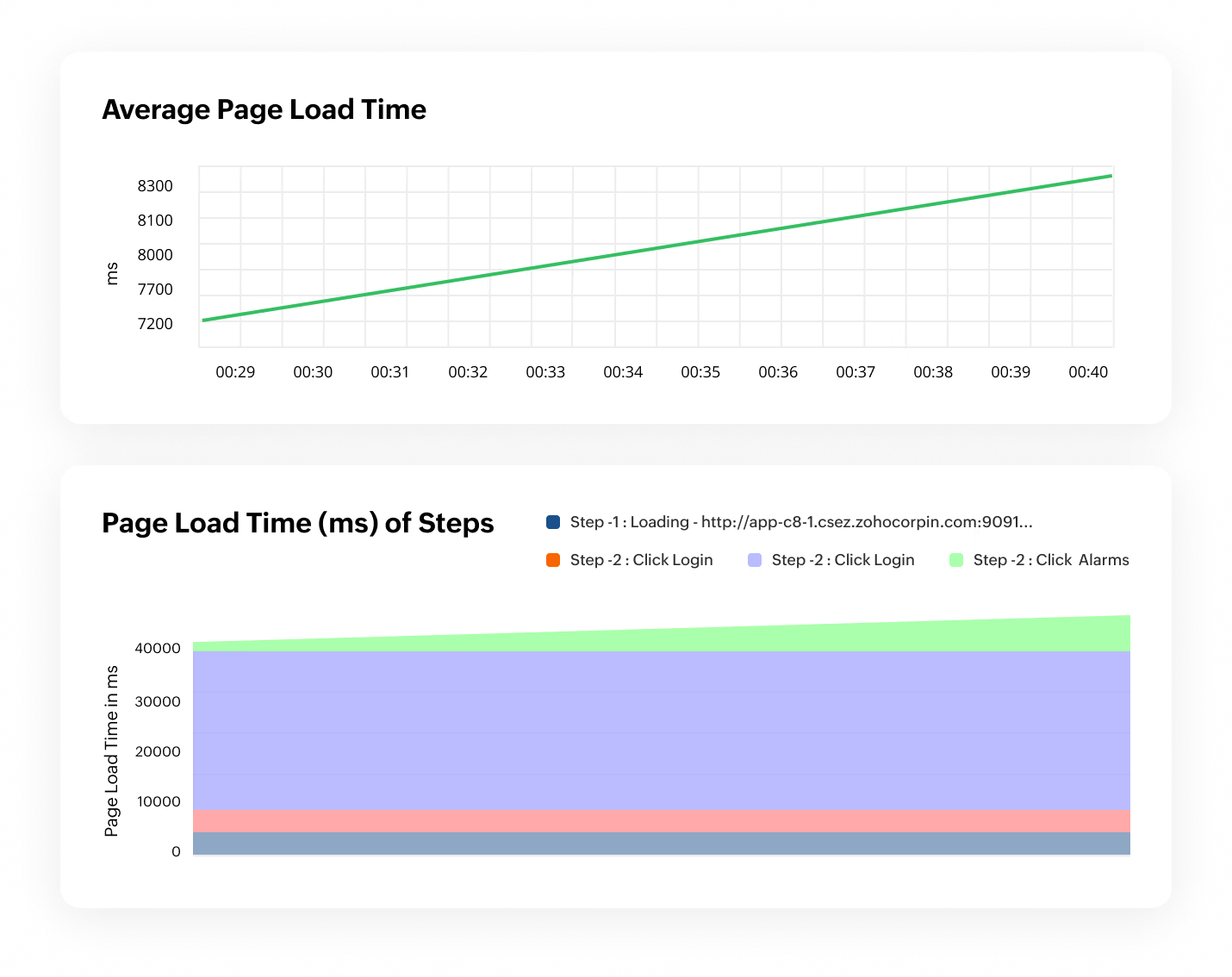
Don't settle for a fragmented view of application performance. As application performance directly translates to user satisfaction and business success, ensuring optimal performance across complex application ecosystems requires a comprehensive approach. By combining synthetic monitoring's proactive capabilities and real user monitoring's (RUM) real-world user insights with traditional application performance monitoring methods, organizations gain a holistic view of application performance. Applications Manager's key features include both synthetic and real user monitoring for a comprehensive end user experience monitoring. By analyzing the user behavior from end-user experience monitoring and data from application performance monitoring, you can:
- Proactively identify issues.
- Gain real-world user experience insights.
- Deliver exceptional user experiences.
Deeper insights with AI-powered advanced analytics
By incorporating machine learning(ML) and time series data, Applications Manager offers a more intelligent and automated approach to application performance monitoring. This translates to significant benefits for organizations seeking to optimize their IT operations and deliver exceptional user experiences.
Historical data analysis
Applications Manager stores extensive time-series data, enabling analysis of historical trends, seasonal patterns, and long-term performance changes.
Predictive reporting
Advanced analytics powered by machine learning predict future trends and uncover hidden patterns. This proactive approach empowers informed decisions and infrastructure optimization.
Dynamic anomaly detection
Applications Manager uses ML to dynamically adjust anomaly thresholds. This minimizes false alarms and pinpoints issues before they become critical, minimizing MTTI and MTTR significantly.
Application performance monitoring in action: Real-world examples
| E-Commerce performance optimization | Challenge: High cart abandonment rates due to slow page load times and errors during checkout. | Applications Manager identifies performance bottlenecks in real-time, such as slow database queries or overloaded servers. By resolving these issues, teams can reduce cart abandonment by 25%. |
| Banking and financial services | Challenge: Latency in transaction processing causing customer dissatisfaction. | ManageEngine’s transaction tracing tracks delays in specific APIs, allowing quick resolution and ensuring seamless transactions. |
| Healthcare application monitoring | Challenge: Downtime in critical patient management systems impacts healthcare delivery. | Proactive monitoring and anomaly detection ensured 24/7 availability of healthcare applications. |
| Hybrid Cloud Monitoring | Challenge: Managing performance across on-premises and cloud environments. | Applications Manager's unified monitoring provided visibility across hybrid systems, across the entire application stack along with its dependencies. |
Applications Manager - the best enterprise application performance monitoring solution
With ManageEngine’s APM tool, business leaders gain more than just a tool—they acquire a strategic partner in digital transformation. Cloud-native and AI-driven, Applications Manager minimizes Mean Time to Recovery (MTTR), reduces operational costs, and elevates customer satisfaction by enhancing digital experiences. With proven ROI and real-time insights, it's trusted by enterprises worldwide for sustained value creation.
| Feature | ManageEngine APM | SolarWinds | New Relic | Elastic Observability |
|---|---|---|---|---|
| Real-time monitoring | ||||
| AI-powered anomaly detection | ||||
| Affordable pricing | (Expensive) | (Expensive) | ||
| Free trial | (30 days) | (14 days) | (7 days) |